Sunday, September 20, 2015

Back to the USA

Brian here:
Well, we are back on United States soil.  Our six weeks' sojourn in Canada was wonderful!

     Our 50 straight days of sleeping in the back of the truck streak ended in Saint John, NB on a rainy day.  We decided to not fight trying to set up in the rain, and felt we had earned an evening without getting wet.  We still had to move just as much stuff around, though.
     We had some Canadian money left, and decided to treat ourselves to a good lunch at a restaurant in Saint Andrews, NB.  There was a nice view of the harbor area (not that we haven't seen lots of them), and it was nice to continue our visit to 'civilization'.  Luckily, our border crossing was easy, and we camped in Maine near the border.  We didn't go far into Maine just then, because we wanted to go back across into Canada to visit Campobello Island the next day.
     It was a treat to spend time at Campobello.  The 'park' is run by a non-profit, but is supported by both the Canadian and US governments.  It is the only International Park that is located entirely in one country.  The Roosevelt 'cottage'  has 34 rooms.  We would settle for one of them!  The grounds are maintained nicely, with flowers all around, and there are nice walking trails.

 FDR's Cottage on Campobello Island

View through dining room window of Hubbard Cottage 

fireplace in Hubbard Cottage

"Sunsweep Scultpure" on Campobello Island - the other two parts of the sculpture are at Lake of the Woods, Minnesota and Point Roberts, Washington


    There is a daily "Tea with Eleanor" in one of the cottages, which we were lucky enough to get to attend.  One of the staff talks about Eleanor's life, and they serve tea and homemade Ginger cookies.  Most people that come to the Island know about FDR, but Eleanor was also an amazing person,  Although the tea sounded pretty dull before I went, it was very enjoyable.
     After another uneventful border crossing, we camped in the same park - it was pretty much deserted, which is the way we like it - we continued on to Acadia National Park.  It is one of our favorites, and it has been 27 years since our last visit.  Our hope was that September would be less busy than the summer months.  I guess we were right, but it was more busy that we would have liked.  I think the other old people have the same idea that we did.
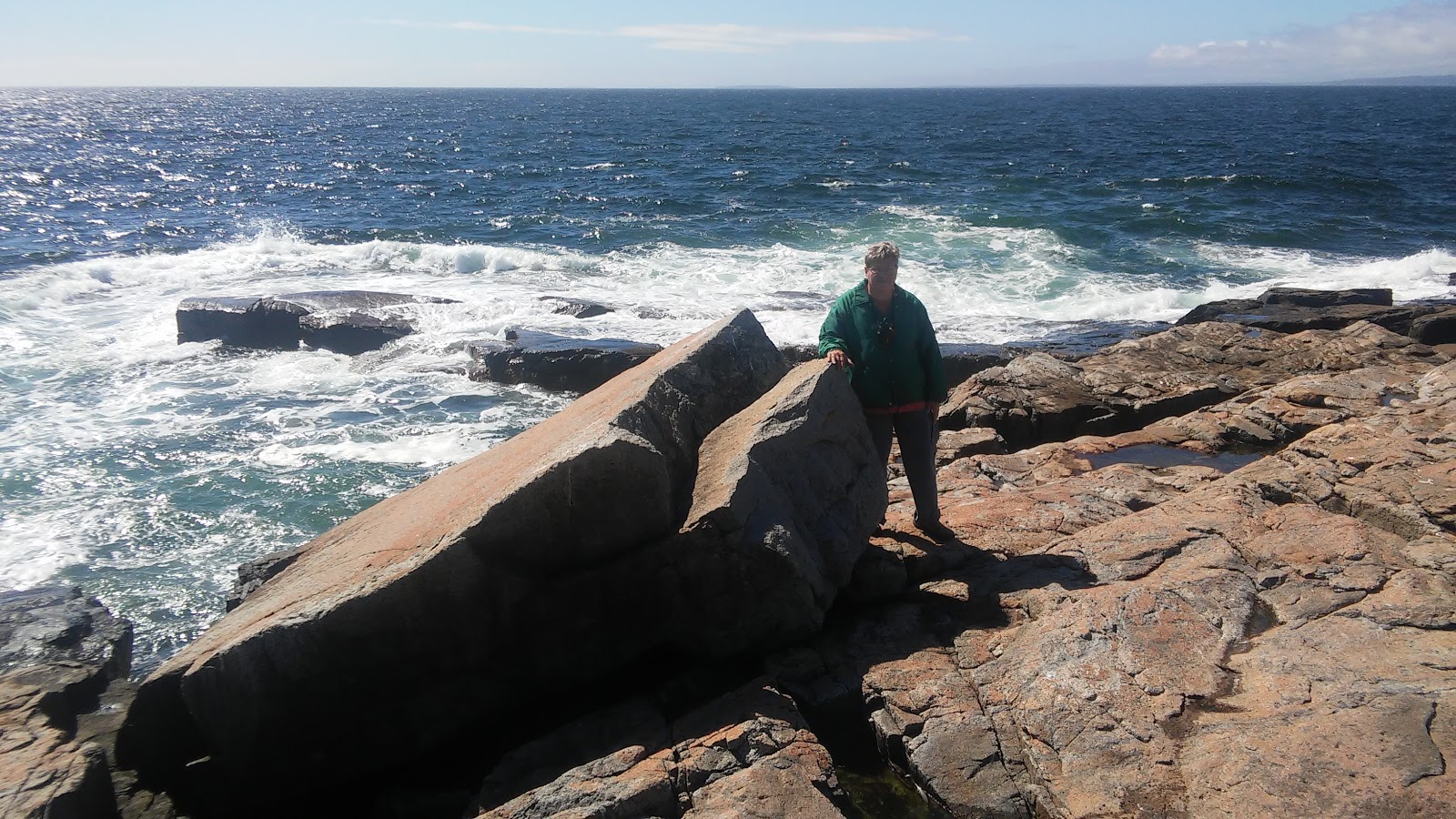
Schoodic Point, Acadia National Park


     We tried to get tickets for a ranger-led boat trip to Little Cranberry Island on our first full day there, but they were sold out, so we bought tickets for two days later and set off for some of the areas of the park that are not as well known.   On the way to visit another lighthouse, we stopped at a cache on the grounds of the Wendell Gilley museum dedicated to bird carving.  Doesn't that sound exciting?   Hey, it wasn't crowded!   We were interested in the concept of the museum, so decided to give it a try.   There were some amazing carvings, but a special exhibit on a local artist, Ashley Bryan, was also fascinating.  He has done many different types of art, and lives on Little Cranberry Island now.


Bass Harbor Lighthouse, Acadia NP

 Great Head, Acadia NP

 Jordan Pond and the Bubbles (mountains)


  After a visit to the lighthouse, we skipped the Granite Museum, and headed back to our campsite for a shower.

     Mount Desert Island is a beautiful place, which is why a lot of it is the National Park.  We did the 'auto tour' the next day to re-visit places we have been to before.  Although we weren't used to the number of people at most of the places, it was better than it would have been during the summer season.   The only time we spent in Bar Harbor was to get groceries so we could cook over a fire instead of on the Coleman stove.  Cadillac Mountain, Sand Beach, Otter Cliffs and Thunder Hole haven't changed much, but Thunder Hole didn't impress since the conditions were just wrong for it to make the noise that it is famous for.

View of Frenchman's Bay and Bar Harbor from Cadillac Mountain

     On our boat trip the next day, we were able to see harbor seals and gray seals.  On Little Cranberry Island, we were able to explore a bit, and saw the church that Ashley Bryan attends, and saw some of his artwork - stained glass made out of beach glass that he discovers on the island.

Ashley Bryan's work in church on Little Cranberry Island

Not the best picture of a gray seal

     We had and early dinner of lobster, which in both of our opinions, is highly overrated for the amount of work involved.  But what tourist could visit Maine without having one?   Our day was ended with a ranger program about the stars.  We laid on a beach, and he pointed out constellations, and some of the stories about them.  The Milky Way was quite impressive, and the conditions were right for us to see many stars that are usually too faint to see.

When in Maine . . . you are required to eat a lobster dinner


     My high school friend, Paul Minot, lives in Waterville, Maine near Augusta, so we stopped to see him.  He is in a band again, and they had a gig at a bar, so we went to see them play.  We stayed up WAY past our usual bed time, but had a good time.  The band has a member  born in each decade from 1955- 1990, so the music mix was varied.

 
   Since Paul had to work both days over the weekend, we are staying so we can visit on Monday.  He recommended the Maiden Cliff hike yesterday near the Camden Hills on the Penobscot Bay, so we headed out to see what it was like.  As with most hikes, the reward of a spectacular view at the end of the hike was worth the effort (well, not the end of the hike, but the farthest point from the parking- you still have to hike back to the car).  We went to a local church in Camden after showering at the State Park,   Chinese take-out was ready when we got back, and we spent the evening talking before we noticed how late it was!

views from Maiden Cliff

interesting tree along the trail


Kris here . . .
     Animal sightings at Acadia NP included a pair of osprey and a red fox on the side of the road after dark (Brian had to brake for it and we only got a glimpse).  We had a pretty good workout while hiking around Great Head.   We have visited Acadia on two previous trips (1978 and 1988) and were happy to see it again.  Now that we are back in the US and have the phone turned on again, it was nice to hear the voices of our children and grandchildren.

Friday, September 11, 2015

On the way to Fundy

Kris here...

      After 13 days and 1,400 miles in Newfoundland, we reluctantly boarded the ferry to return to Nova Scotia. We opted for the night crossing this time. Hard to rest with strangers snoring around you, so we arrived back in North Sydney, NS a bit fatigued. First order of business - oil change and brake job, then off for a short visit to the Marconi National Historic Site in Glace Bay.

      We devoted most of the next day to Louisbourg National Historic Site, the French colonial capital 1713-1758. Parks Canada has done a remarkable job reconstructing about 25% of the site using the original written plans. Costumed actors helped make it an interesting visit. We also hiked around the ruins that have not been reconstructed.

Fortress at Louisbourg National Historic Site 

Firing the cannon


       Next, back to Cape Breton Highlands National Park, this time on the eastern side around Ingonish. Hikes to a waterfall, around a small lake, and out to the end of Middle Head that separates Ingonish Bay into two parts kept us busy. We couldn't leave Cape Breton Island without attending a ceilidh (pronounced kay-lee) with traditional fiddle music and dance. We heard about one at a local church hall and spent the evening enjoying the entertainment.

 Mary Ann Falls, Cape Breton Highlands NP

 Middle Head, Ingonish Bay

The view from the end of  Middle Head

       We returned to mainland Nova Scotia and followed the south shore to Halifax, making short stops at historic sites along the way. One of our campsites was right on the beach – it's nice falling asleep to the sound of the surf.

       Our next major stop was Kejimkujik National Park. We enjoyed hiking the trails and a tour of the petroglyphs there with a Mi'kmaw park naturalist who told us some of the stories passed down by her ancestors. “Keji” is a designated Dark Sky Preserve and we had some clear nights to look at the stars and see the Milky Way spread across the night time sky. You don't get to do that anywhere near Houston!


 Mills Falls on the Mersey River, Kejimkujik National Park, Nova Scotia

Kejimkujik Lake

        We needed a place to spend the Labour Day weekend, so we stayed in a campground in the Annapolis River Valley, east of Digby. (We steered clear of the Wharf Rat Motorcycle Rally in Digby).  One interesting stop was a Tidal Power Generating Station on the Annapolis River. We also enjoyed the Port Royal National Historic Site, a reconstructed settlement circa 1605. Costumed actors were demonstrating woodworking, carpentry, blacksmithing, etc. There were clothes you could try on and I gave the wooden shoes a try . . . very uncomfortable.

 Documenting the tide status at the Tidal Power Generating Station for an Earthcache.

 Standing in wooden shoes was okay, but walking around was a bit tricky.

 Cheers!

Hard to see, but Kris is poking her head out of the window at the Port Royal Habitation.


       Grand Pre National Historic Site has a UNESCO designation because of the landscape that is a result of Acadian farming practices up to the time of the Deportation of French-speaking inhabitants in the 1750s. A statue of Longfellow's heroine Evangeline has a prominent spot in the park. (Note to self: I should read that epic poem sometime now that I have a better understanding of the historical events of the time.)

Beautiful gardens at Grand Pre


Statue of Longfellow's heroine, Evangeline

        For the next week, we followed the shores along the Bay of Fundy on both the Nova Scotia and New Brunswick sides, stopping a lighthouses and beaches at low tide. One stop was at Burntcoat Head where the highest tides in the world occur, about 50 feet difference between high and low. We were lucky enough to have good timing and observed a tidal bore on the longest river in Nova Scotia. We visited geology related museums including Joggins Fossil Cliffs where the earliest lizard fossils have been found. We went on a tour and found fossils in the cliffs and on the beach. Great fun for a couple of science nerds!


It's hard to see Brian in the window at the top

Low tide

          Back into New Brunswick on September 8 and a three-day visit to Fundy National Park. Our last visit to the park was in 1988 (Mark was 18 months old and Phillip wasn't even born yet). We observed high and low tides in several places, including Point Wolfe. Kim remembers the location and she was only 7 years old at the time. We hiked every day and completed a geocaching challenge sponsored by Parks Canada. We made a side trip to Cape Enrage and observed the Bay of Fundy from that vantage point.
 Alma Harbour, high tide


 Alma Harbour, low tide

Point Wolfe Estuary, low tide
Fundy National Park

 Point Wolfe Estuary, high tide
Fundy National Park

 Barn Marsh Beach below Cape Enrage,  New Brunswick


Dickson Falls, Fundy NP

        Our time in Canada is almost over. People have been friendly and we get stopped every now and then by people who are curious about our truck and camper. The campground at Fundy had a communal campfire pit and we enjoyed evenings sharing our adventures with fellow campers, including some from Europe.

       Our next objective is Maine and watching tree leaves change colors. We have seen a hint of yellow in the birch leaves already.

Brian's two cents :

Not much to add to what Kris said. We have NOT been going crazy doing Geocaches. We have averaged about ten a day, and they are usually where we are going anyway. Right now, we are sitting at our campsite in Fundy, and I'm watching a squirrel jumping around and looking for a handout.

As she said, it has been a super visit to Canada, but it is time to get back to the USA where we don't have to do mental conversions of kilometres to miles or Celcius to Farenheit! Everyone has been saying that we must be loving the good US to Canadian exchange rate. Well, it is good when I take $300 Canadian out of the ATM, and it comes out of our account as $245 U.S., but a pound of bananas is about a dollar, so we are only saving money from what Canadians pay. It is still more than what we pay for most things at home!  And there is a 15% sales tax ... even postage stamps are taxed.
I'm looking forward to seeing a high school friend, Paul Minot, next weekend. He plays in a band, and we are planning on going to see them perform.


 "I think this is the right way to the oldest cache in Canada."

 Canada's first geocache - placed June 2000 (Nova Scotia)

Tuesday, August 25, 2015

Newfoundland - part 2

Newfoundland again. I need a thesaurus to find words to describe what we've seen! We are into week ten now, which is a record for us, and we just now are headed south again. I checked the other day, and it was 2500 miles in a straight line to Houston.

I guess we left off at Terra Nova Natl. Park. Teachers started back to work Monday a week ago, but we were stuck here in Newfoundland. Why not take a hike? We started the day with a walk to the top of Ochre Hill . There was a beautiful panoramic view of the bays, ponds, and mountains all around. We ran into just one other person on our hike.
 

                                    From the top of Ochre Hill in Terra Nova National Park


There are a lot of peninsulas around the island. There are too many for us to explore them all, so we chose Cape Bonavista as one of them. There is a collapsed sea cave called The Dungeon that was a must-see, and a historic lighthouse near where it is has been agreed upon that John Cabot landed. There is a little island near the lighthouse that is a nesting place for puffins. It was fun to see where they live, and we were lucky enough to see a few coming and going from their burrows. Even with the orange beak, they are hard to spot. Our campground that night was about 6 km (3.6 miles) down a very bumpy road. We were glad we only had to take the round trip once.
 
The Dungeon

Cape Bonavista Lighthouse

View from Cape Bonavista

The big city of St. John's was our next stop (pop. 100,000). Still, 'city driving' is not fun, especially when you aren't sure where you are going. St. John's is known for the colorful houses, but we didn't stop to take many pictures of them. We spent our time at two historic sites- Cape Spear and Signal Hill.
      Cape Spear is the easternmost point of North America, not counting Greenland, so we had to go there to get a geocache names “Extreme East”. Signal Hill is above the harbor entrance, and has been the site of many battles between the French and British. At the top is a stone building called Cabot Tower. Early radio transmissions were received here, and there is a recreation of the radio room.
As far east as you can go by car - Cape Spear

Cape Spear Lighthouse

Cabot Tower on Signal Hill

Looking down from Signal Hill as a ship entered St. John's Harbor

Kris signing the log of a geocache below Cape Spear Lighthouse - a precarious perch


On Signal Hill, there is an attraction called GeoCentre. It is a museum about geology UNDER the hill. They carved the museum into the rock of the Signal Hill. We decided to spend another day in St. John's to see what it is like. You can see all of the layers going back billions of years. It was quite informative, and not too busy, so we really enjoyed the day not driving around.

It was time to escape the big city. We traveled west to Placentia Bay and Castle Hill National Historic Site. There are remains of French and British forts there, along with the history of how forts have changed due to technology. Gunpowder and rifles barreled guns made a lot of difference!

It would have been nice to visit France – There are two French islands off of the coast of Newfoundland, but it was too much money to justify a visit to France, although it would have been a new country to Geocache in!

The Trans Canada Highway isn't very busy compared to Houston freeways, and is a comfortable drive. The only problem was that I drive the speed limit, so people were frequently on our tail. One good thing, though, is that they actually use their turn signals to pass! Amazing, for sure.

Well, we've gone as far east as we can, so why not head farther north?  One of the places we HAD to go back to was Gros Morne National Park on the west coast. We camped another night, and then headed north to L'Anse aux Meadows, where the Vikings had a short-lived settlement in 1000 A.D.. We took an excellent tour, guided by a local man that grew up playing on the 'Indian Mounds' that turned out to be the remnants of the Viking dwellings. National Parks always have interesting guided tours, but we have been very lucky this trip to have two guided by people with direct connections. This guide worked on the archeological digs in the area and helped reconstruct the buildings that are used in the living history exhibit.


                                                  Brian strikes a pose with Leif Ericson

Our tour guide with remains of the original Viking dwellings behind them.  
They were excavated and then covered over to preserve them.


A reconstructed Viking dwelling with sod walls 6 feet thick

Inside a reconstructed house


Another historic site on the northern peninsula is in Port Au Choix, where four different prehistoric groups of people have lived over the course of 5,000 years. We took a short hike on one of the trails, and were lucky enough to see a lone caribou on our walk.

We took a short hike on Raven Trail that is the northern terminus of the IATNL – International Appalachian Trail Newfoundland – but we haven't been able to learn much about it. It was another wonderful view (this time on the first day the kids were back to school) and this time, we didn't see ANY people!

The view from Cape Raven (and a geocache)

Today, we did the tourist thing and took a boat tour on Western Brook Pond, an ancient fjord that is now a freshwater lake. The two-hour ride was breathtaking, and well worth the 3 kilometer hike to get to the boat dock. I liked the fact that I wasn't doing the driving.
                                          Western Brook Pond - Gros Morne National Park


Our boat trip on Western Brook Pond


Kris here – my 2 cents worth:
We had planned on spending one week in Newfoundland but extended our visit to two weeks. Although we could see Labrador across the Strait of Belle Isle about 25 km away, we had to draw the line somewhere so we didn't take the ferry across to visit it. L'Anse aux Meadows was well-worth the drive up to the end of the Northern Peninsula. It is a UNESCO World Heritage Site (as is Gros Morne NP) and I have always been intrigued by the place. I wasn't sure we were going to have time to visit, but adding the time to our Newfoundland expedition made it possible. We saw a 10-foot statue of Leif Ericson that was a tribute to all people of Scandinavian heritage so it was fitting that I saw it and thought of my Norwegian ancestors. The tour guide was excellent and is a living witness to the discovery of the ruins and played a role in the preservation. He has worked for Parks Canada for almost 50 years and really knew his “stuff.”
Surprisingly, we haven't seen much wildlife. Too late in the summer to see whales, but NFLD supposedly has the highest population density of moose anywhere in the world and we haven't seen even one, despite the ubiquitous warning signs along the highways. I was thrilled to see one caribou, a handful of puffins, and a hare that hopped through our campsite last evening.

We have booked a night crossing on the ferry back to Nova Scotia where we will resume our sojourn at Cape Breton Highlands National Park.

Geocaching warning!
This trip hasn't been all about caching. Yes, we look at them, but we are fairly picky. We have averaged about ten finds a day. We aren't racking up big numbers, but we have found quite a few places that we wouldn't have seen if there wasn't a geocache there.